Observe behavior in context
Collect process ancestry, command-line activity, script execution and file-system events. Network context helps identify unusual destinations, lateral movement patterns and activity outside an established baseline.
Behavioral AI and machine learning designed to support enterprise threat classification, investigation and policy-driven response.
NeuralGuard evaluates the relationships between activity on a protected system. A legitimate tool can be used maliciously; the surrounding process, identity, file and network behavior helps the engine distinguish routine administration from an emerging attack.
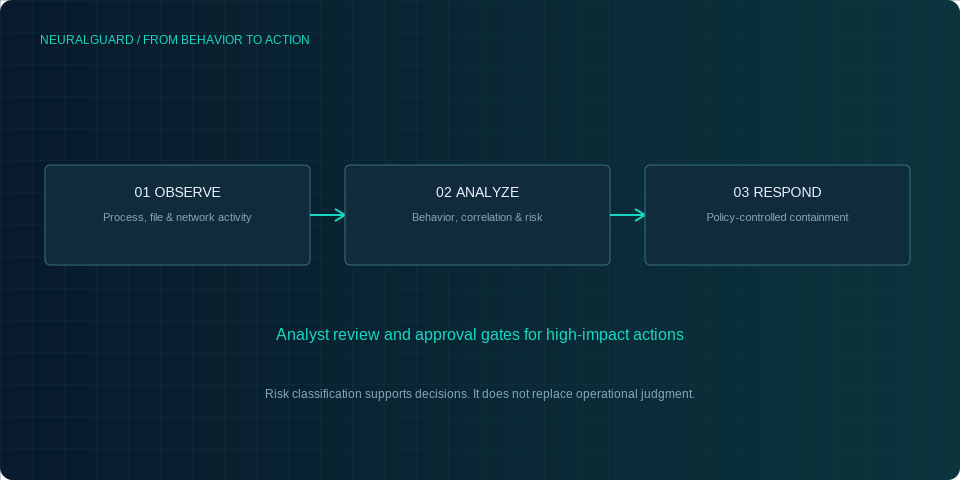
Collect process ancestry, command-line activity, script execution and file-system events. Network context helps identify unusual destinations, lateral movement patterns and activity outside an established baseline.
Machine-learning models and detection rules assign a risk classification. A score helps prioritize review, but is not a guarantee that an event is malicious. Analysts inspect the supporting evidence and applicable policy.
Link a suspicious script to credential access attempts, network activity and destructive file operations. Correlated context gives analysts a more complete investigation path than an isolated alert.
A suspicious pattern is evaluated against administrator-defined response rules. Depending on confidence and business impact, the result may be an alert, approval request or permitted containment action.
Models can generate false positives and require monitoring. Critical workloads use conservative rules, exception review and controlled policy changes. AI complements analyst judgment and change management.
Explore endpoint and server defense for your enterprise environment.